How accurate is AI accounting software? What to test before you trust it
No published accuracy percentage tells you whether AI accounting software is right for your books, because vendors measure it on their own data. In our internal benchmarks, Accountable is 99% accurate and makes 90% fewer mistakes than a human bookkeeper. Test any tool, ours included, on a month you already know: compare categories with your CPA's, reconcile each account to the bank to $0.00 and read every adjustment.
Updated · 5 min read · By the Accountable team
- Pick a month you knowOne your CPA or bookkeeper already closed
- Load it and compareCount the categories that differ from the answer key
- Reconcile to the bankEvery account ties to its statement, to $0.00
- Read adjustments, then undo oneNo plug entries, and a change you can reverse
The test is yours to run before you pay. It needs one closed month and about an hour.
The short version
- Accuracy has two parts: whether each transaction has the right category, and whether the books match the bank.
- Vendors' accuracy figures are self-reported, and Digits' "more than 95% auto-booked" counts how often it posts without asking, not how often it is right.
- In an independent 2025 test by Penrose, the best AI models started within 1% of a CPA's books and drifted to more than 15% off as errors compounded.
- In our internal benchmarks, Accountable is 99% accurate and makes 90% fewer mistakes than a human bookkeeper, and we still recommend you test it on your own month.
- A month is proven when each account's ledger balance equals the bank statement's ending balance with no plug entries.
Accuracy is five measures, and a single percentage hides four of them
A tool can be right on 98 of 100 transactions and still have put a large equity investment in revenue. Ask for these five measures, not one number. The flagship comparison of AI accounting software for startups shows which tools publish what.
| Measure | How to calculate it | What to ask for |
|---|---|---|
| Category accuracy | Transactions whose category matches your answer key, divided by all transactions | The count of wrong rows, not only the percentage |
| Weighted error | Add the amounts of the wrong rows and compare with total spending and revenue | Whether the wrong rows are large or small |
| Review rate | Share of transactions the tool sent to you instead of posting silently | A tool that never asks is not necessarily right |
| Bank match | Ledger balance minus the statement's ending balance, for each account | $0.00, or a listed pending item |
| Adjustments | Entries added by hand or by the AI to make a number match | Zero unexplained plug entries |
A one-hour test plan: seven steps to run before you trust any tool
Step 1: Choose one month your CPA or bookkeeper already closed. Their categories are your answer key.
Step 2: Load the same month into the tool. Most have a free plan or trial, and Accountable Free categorizes the first 100 transactions a month.
Step 3: Compare each category with the answer key and count the differences. Sort the differences by amount and note the largest.
Step 4: Reconcile every bank and card account to its statement. Write down any difference that is not $0.00.
Step 5: Read every adjustment and manual entry. Each one needs a reason you understand.
Step 6: Include three awkward cases: a transfer between your own accounts, a refund, and a founder's loan or investment. These are the ones that go wrong quietly.
Step 7: Make one change and undo it, then open the log and check that it names who made each change.
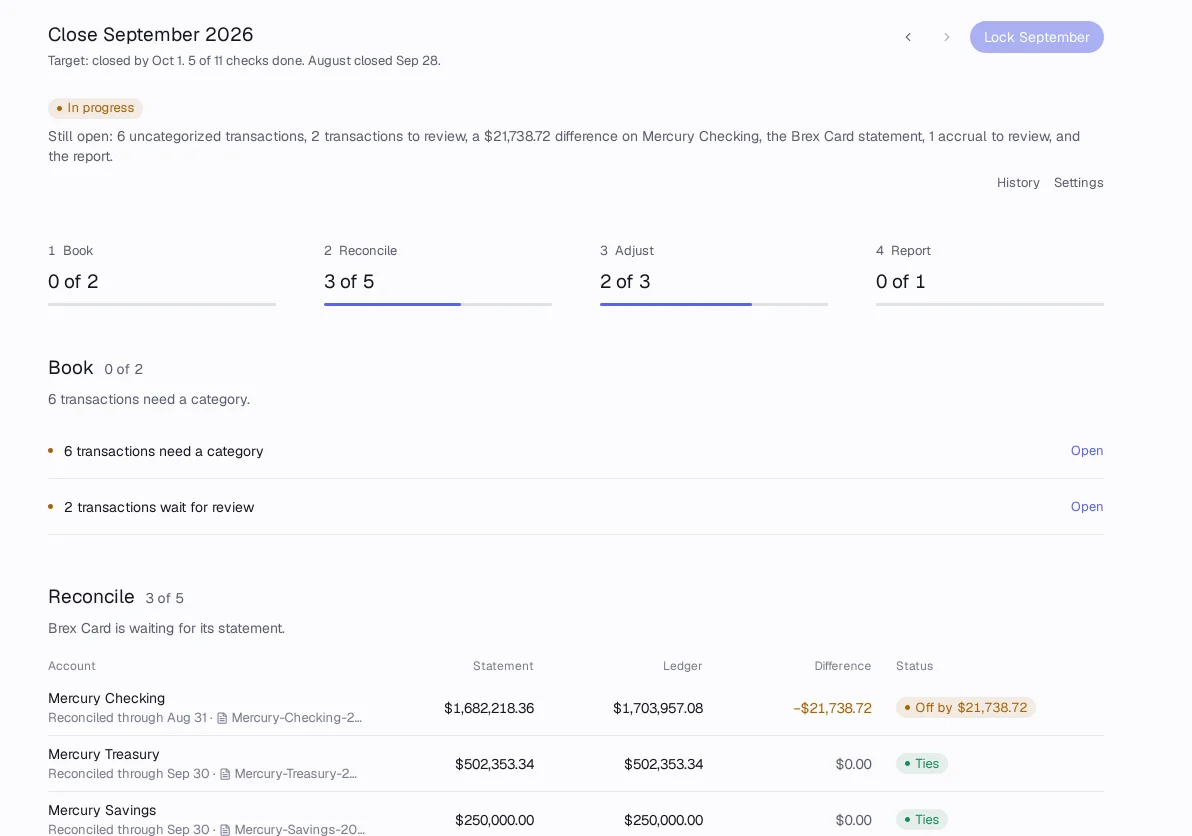
Score the tool on the five measures above. If it fails on bank match or leaves unexplained adjustments, do not rely on it, whatever its percentage says.
What the published evidence says, and what it leaves out
Penrose's AccountingBench from 2025 is the best independent test. It gave AI models a real software company's raw bank, card, payroll and payment data, asked them to close the books month after month, and compared the result with a CPA's. The strongest models stayed within 1% early on, then drifted to more than 15% off as each month inherited the last month's errors. Those were 2025 models, and newer ones may do better.
Vendors grade their own work. Digits says its AI auto-books more than 95% of transactions, which measures how often it posts, not how often it is right. Intuit's researchers report that a new QuickBooks categorization model beats its production model. In our internal benchmarks, Accountable is 99% accurate, 100 times faster than a human accountant and makes 90% fewer mistakes than a human bookkeeper, and that is our own measurement, so run the test above before you rely on it.
For the monthly check and the reasoning behind it, read is AI bookkeeping accurate and how AI bookkeeping works.
Six quiet errors a good test catches
- A transfer between your own accounts counted as income or spending, which inflates both revenue and expenses.
- A duplicated payment, which makes the ledger higher than the statement by exactly that amount.
- A plug entry added to force a reconciliation, which makes the books match the bank and still be wrong.
- A loan or equity investment booked as revenue, which overstates profit.
- A transaction in the wrong period, which makes one month too high and the next too low.
- A tool that posts every row without asking, which hides its doubts instead of showing them.
Accountable shows the reason and how sure it was on every row, holds doubts in a review queue, locks a month only when each account matches its bank statement, and lets you undo any change. Your CPA should still read the year before you file. Whether a change is safe to leave to the AI is covered in is AI accounting software safe.
Questions founders ask
How accurate is AI accounting software?
It is accurate on routine transactions and needs checking on unusual ones. No published figure replaces your own test: each account's ledger balance should equal its bank statement balance, with a difference of $0.00.
Is a 1% error rate acceptable in accounting?
It depends on which 1% is wrong. A few small mislabeled rows barely move your statements, while one misbooked investment can overstate profit, so ask for the wrong rows by amount.
How do I test AI accounting software before I buy?
Load a month your CPA already closed, compare the categories, reconcile each account to the bank and read every adjustment. The test plan above takes about an hour.
Do AI accounting errors get worse over time?
They can. In Penrose's 2025 test, errors compounded because each month started from the last month's books. Reconciling every month to the bank stops that.
Do I still need a CPA if the AI is accurate?
Yes. Your CPA prepares and signs the tax return and reviews judgment calls, and the IRS holds you responsible for your records whichever software made them.
Every month matches your bank, to the cent
Accountable (accountable.im) shows the reason for every category, checks each account against its bank statement before a month can lock, and lets you undo any change. Read AI accounting software for startups for how it compares, see how it differs from Puzzle, or browse all startup accounting guides.
Start freeSources, checked October 4, 2026:
- Penrose: AccountingBench, evaluating LLMs on real long-horizon business tasks
- Digits press release, April 21, 2026 (Yahoo Finance copy)
- Intuit researchers: Transaction Categorization with Relational Deep Learning in QuickBooks (ECML-PKDD 2025)
- IRS Publication 583: Starting a Business and Keeping Records
- Accountable pricing